概述
在python中,str(字符串)在内存中是Unicode编码,是以字符为单位的,一个字符对应若干个字节
bytes是以字节为单位的
str与bytes可以互相转换
什么时候需要str转换成bytes
而在网络上传输,或者保存到磁盘上,是以 字节 为单位操作的,此时就需要把 字符串 转换成 字节
str与bytes互相转换
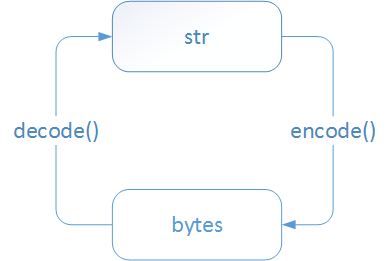
str转bytes,用encode()编码
bytes转str,用decode()解码
str转换成bytes
方法1
通过str的encode()方法实现,说明见链接:
http://www.runoob.com/python/att-string-encode.html
s='你好,Python'
#用UTF-8编码格式
b=s.encode('utf-8')
print(b)
结果如下:
b'\xe4\xbd\xa0\xe5\xa5\xbd\xef\xbc\x8cPython'
\x表示16进制
方法2:
使用bytes()实现
s='你好,Python'
#用UTF-8编码格式
b=bytes(s,'utf-8')
print(b)
bytes转换成str
通过bytes的decode()方法实现
语法:
#用UTF-8编码格式
decode(encoding='UTF-8',errors='strict')
参数:
encoding : 要使用的编码,如”UTF-8”。
errors : 有些字符无法转换时,设置不同错误的处理方案。
- ‘strict’,默认值,意为编码错误引起一个UnicodeError。
- ‘ignore’:忽略非法字符
- ‘replace’:用?取代非法字符
- ‘xmlcharrefreplace’:用XML的字符引用替换不支持的字符(仅在写入文件时支持)
- ‘backslashreplace’:用Python的反向转义序列替换格式错误的数据
以及通过 codecs.register_error() 注册的任何值。
返回值:
- 该方法返回解码后的字符串。
例子:
b=b'\xe4\xbd\xa0\xe5\xa5\xbd\xef\xbc\x8cPython'
s2=b.decode('utf-8')
print(s2)
显示结果如下:
你好,Python
感谢:
https://www.cnblogs.com/654321cc/p/7419124.html
https://cloud.tencent.com/developer/ask/187671