介绍
将 r 维的list 堆叠 成 r+1 维
语法
tf.stack(
    values,
    axis=0,
    name='stack'
)
参数:
- values:list类型,其元素是Tensor(shape和dtype都相同)
- axis:按照哪个轴堆叠。默认第1个轴
例子
一维数组
x = tf.constant([1, 4])
y = tf.constant([2, 5])
z = tf.constant([3, 6])
测试代码
a=tf.stack([x, y, z])
print(a)
执行结果如下:
tf.Tensor(
[[1 4]
[2 5]
[3 6]], shape=(3, 2), dtype=int32)
理解: 3个元素按照0轴进行堆叠,所以结果的tensor张量
0轴为3,由于原数据形状是2,所以结果的tensor张量1轴为2,即:结果tensor形状为(3,2)
测试代码
b=tf.stack([x, y, z], axis=1)
print(b)
执行结果如下:
tf.Tensor(
[[1 2 3]
[4 5 6]], shape=(2, 3), dtype=int32)
理解: 3个元素按照1轴进行堆叠,所以结果的tensor张量
1轴为3,原数据形状是2,所以结果的tensor张量0轴为2,即:结果的tensor形状为(2,3)
二维数组
x = tf.constant([[1, 4, 7],[10, 13, 16]])
y = tf.constant([[2, 5, 8],[11, 14, 17]])
z = tf.constant([[3, 6, 9],[12, 15, 18]])
测试代码
a=tf.stack([x, y, z])
print(a)
执行结果:
tf.Tensor(
[[[ 1  4  7]
[10 13 16]]

[[ 2  5  8]
[11 14 17]]

[[ 3  6  9]
[12 15 18]]], shape=(3, 2, 3), dtype=int32)
理解: 3个tensor按照0轴进行堆叠,所以结果的tensor张量
0轴为3,原数据形状是(2,3),即:结果的tensor形状为(3,2,3)
测试代码
b=tf.stack([x, y, z],axis=1)
print(b)
执行结果如下:
tf.Tensor(
[[[ 1  4  7]
[ 2  5  8]
[ 3  6  9]]

[[10 13 16]
[11 14 17]
[12 15 18]]], shape=(2, 3, 3), dtype=int32)
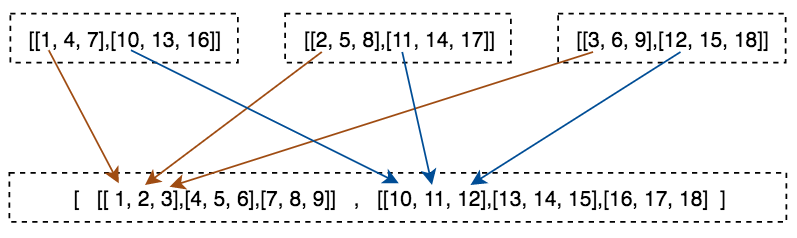
理解: 3个tensor按照1轴进行堆叠,所以结果的tensor张量
1轴为3,原数据形状是(2,3),即:结果的tensor形状为(2,3,3)
测试代码
c=tf.stack([x, y, z],axis=2)
print(c)
执行结果:
tf.Tensor(
[[[ 1  2  3]
[ 4  5  6]
[ 7  8  9]]

[[10 11 12]
[13 14 15]
[16 17 18]]], shape=(2, 3, 3), dtype=int32)
理解: 3个tensor按照2轴进行堆叠,所以结果的tensor张量
2轴为3,原数据形状是(2,3),即:结果的tensor形状为(2,3,3)