提出问题
问题一
flink 收到一条数据后,根据该条数据,要对 redis,hbase 进行查询、修改、删除等操作
问题二
flink 收到一条数据后,由于该数据不完整,要调 api 填充缺失的信息
分析-使用 MapFunction 算子
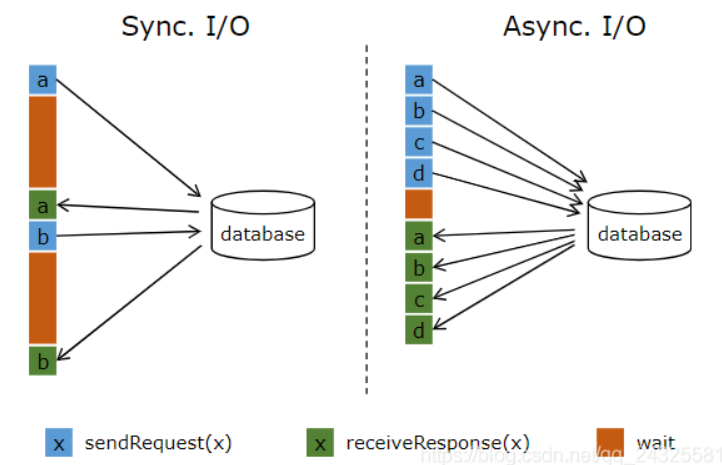
一般在 MapFunction 这类算子中进行 操作数据库、调用 api 的操作,是以 同步方式 操作的,即: 前一个数据处理完后,才处理下一个数据
缺点: 前一个数据,要到外部数据库中(hbase、MySQL)进行增删改查,此时可能会发生IO阻塞,等待请求返回,这种同步交互的方式往往在网络等待上就耗费了大量时间 。前一个数据处理后,才会继续处理下一个数据,性能低下
例子
package hbase;

import org.apache.flink.api.common.functions.FlatMapFunction;
import org.apache.flink.api.common.functions.MapFunction;
import org.apache.flink.api.java.tuple.Tuple2;
import org.apache.flink.streaming.api.datastream.AsyncDataStream;
import org.apache.flink.streaming.api.datastream.DataStreamSource;
import org.apache.flink.streaming.api.datastream.SingleOutputStreamOperator;
import org.apache.flink.streaming.api.environment.StreamExecutionEnvironment;
import org.apache.flink.streaming.api.functions.async.AsyncFunction;
import org.apache.flink.streaming.api.functions.async.ResultFuture;
import org.apache.flink.util.Collector;

import java.util.Collections;
import java.util.concurrent.TimeUnit;

public class Std1FlatMap {
    public static void main(String[] args) throws Exception {
        StreamExecutionEnvironment env = StreamExecutionEnvironment.getExecutionEnvironment();
        env.setParallelism(1);
        DataStreamSource<String> dss = env.fromElements(
                "1李雷 2lucy",
                "3韩梅梅 4lili",
                "5李雷 6韩梅梅");
        // map解析json数据
        SingleOutputStreamOperator<Tuple2<String,Integer>> mapSOSO = dss.flatMap(new FlatMapFunImpl());

        SingleOutputStreamOperator<Object> soso = mapSOSO.map(new MapFunction<Tuple2<String, Integer>, Object>() {
            @Override
            public Object map(Tuple2<String, Integer> value) throws Exception {
                Thread.sleep(500);
                System.out.println(String.format("模拟从数据库查询数据消耗的时间::%s ms",500 ));
                return value;
            }
        });
        soso.print();
        env.execute();
    }
    public static class FlatMapFunImpl implements FlatMapFunction<String, Tuple2<String,Integer>> {
        @Override
        public void flatMap(String value, Collector<Tuple2<String, Integer>> out) throws Exception {
            String[] arr = value.split(" ");
            for(String item : arr){
                out.collect(Tuple2.of(item,1));
            }
        }
    }
}
问题与解决
与外部系统交互时,网络延迟成为系统瓶颈,前一个数据处理慢,后面的数据都处于等待
使用 Flink Async I/O 异步处理
Async I/O
Flink 在 1.2 中引入了Async I/O,在 异步模式 下,将IO操作异步化,并行发送多个请求,哪个先执行完就先返回,不需要阻塞等待,大大提高了流处理效率。
注意:要求外部系统客户端支持异步IO,否则需要 自定义实现异步IO
AsyncDataStream 类
有两个静态方法:
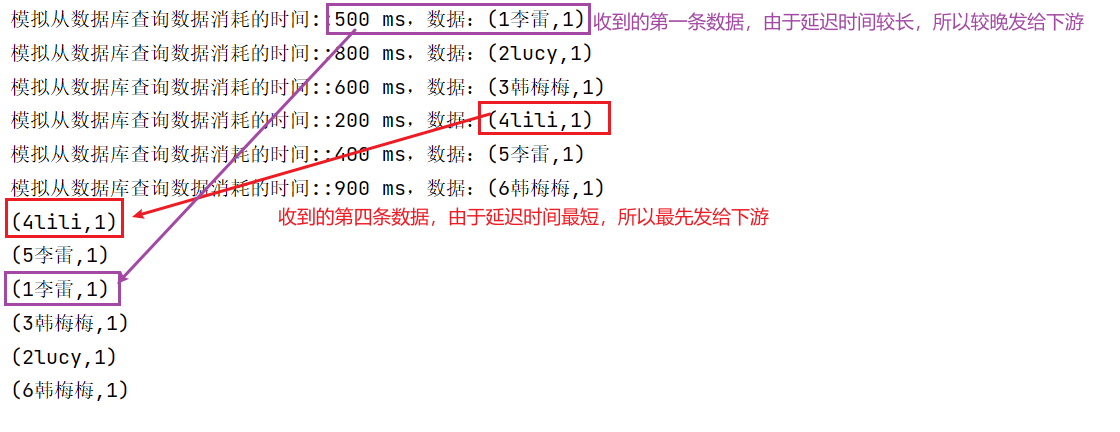
unorderedWait,不关注顺序,哪个任务先执行完,就先返回数据
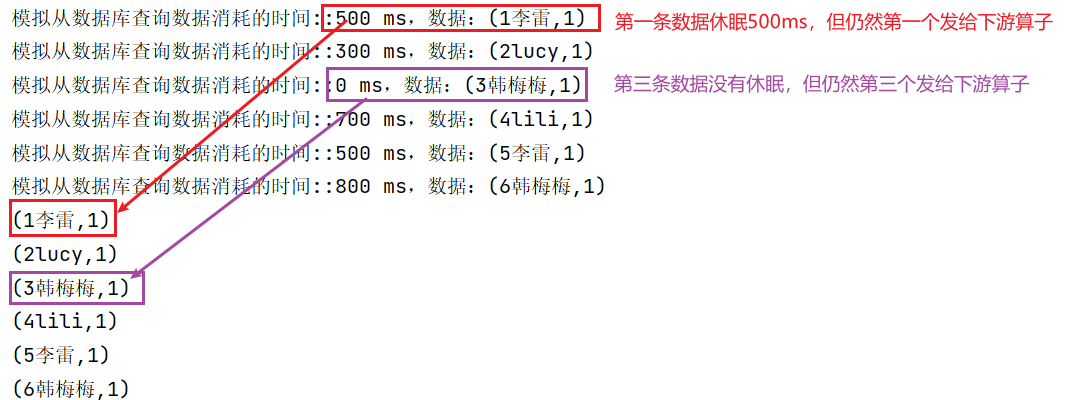
orderedWait,关注顺序,输出的顺序和输入的顺序是一样的
unorderedWait() 方法
表示数据 不需要关注顺序,异步请求执行结束后,立即输出结果
假设:前一个数据,处理时间需要 6秒,后一个数据,处理时间需要 3秒,执行结果:由于后一个数据处理时间较短,所以 后一个数据的结果会先输出
参数解释:
第一个参数:上游
datastream流第二个参数:自己实现的类,需要继承
RichAsyncFunction类或者 实现AsyncFunction接口。一般继承RichAsyncFunction,有生命周期方法第三个参数:是最长等待时间
第四个参数:是
TimeUnit可以传入TimeUnit.SECONDS这种最后一个参数:表示同时最多有多少个异步请求在处理,异步IO的方式会导致更高的吞吐量,但是对于实时应用来说该操作也是一个瓶颈。限制并发请求数,算子不会积压过多的未处理请求,但是一旦超过容量的显示会触发背压。
该参数可以不配置,但是默认是100
AsyncFunction 类
有 asyncInvoke() 方法,用于异步执行,形参:
- 第一个形参是传入的数据
- 第二个形参用于收集返回的数据
RichAsyncFunction 类
有以下方法:
open()方法:初始化方法,被调用之前,open()会被调用,只会执行一次。如:连接数据库asyncInvoke()方法,用于异步执行,形参:- 第一个形参是传入的数据
- 第二个形参用于收集返回的数据
close()方法:是生命周期中的 最后一个调用的方法,做一些清理工作。如:关闭数据库
例子-失败
本例子只是简单使用,虽然使用异步的 AsyncFunction 类,但客户端不支持异步IO,也没有自定义实现异步IO,所以执行时还是 同步的
package hbase;

import org.apache.flink.api.common.functions.FlatMapFunction;
import org.apache.flink.api.java.tuple.Tuple2;
import org.apache.flink.streaming.api.datastream.AsyncDataStream;
import org.apache.flink.streaming.api.datastream.DataStreamSource;
import org.apache.flink.streaming.api.datastream.SingleOutputStreamOperator;
import org.apache.flink.streaming.api.environment.StreamExecutionEnvironment;
import org.apache.flink.streaming.api.functions.async.AsyncFunction;
import org.apache.flink.streaming.api.functions.async.ResultFuture;
import org.apache.flink.util.Collector;

import java.util.Collections;
import java.util.Random;
import java.util.concurrent.TimeUnit;

public class Std2AsyncDataStream {
    public static void main(String[] args) throws Exception {
        StreamExecutionEnvironment env = StreamExecutionEnvironment.getExecutionEnvironment();
        env.setParallelism(1);
        // 测试数据
        DataStreamSource<String> dss = env.fromElements(
                "1李雷 2lucy",
                "3韩梅梅 4lili",
                "5李雷 6韩梅梅");
        // map解析json数据
        SingleOutputStreamOperator<Tuple2<String,Integer>> mapSOSO = dss.flatMap(new FlatMapFunImpl());

        SingleOutputStreamOperator<Object> soso = AsyncDataStream.unorderedWait(mapSOSO, new AsyncFunction<Tuple2<String, Integer>, Object>() {

            @Override
            public void asyncInvoke(Tuple2<String, Integer> input, ResultFuture<Object> resultFuture) throws Exception {
                int delay = new Random().nextInt(10) * 100;
                System.out.println(String.format("模拟从数据库查询数据消耗的时间::%s ms",delay ));
                Thread.sleep(delay);
                // 通过下面方法收集数据
                resultFuture.complete(Collections.singleton(input));
            }
        }, 60, TimeUnit.SECONDS);
        soso.print();
        env.execute();
    }
    public static class FlatMapFunImpl implements FlatMapFunction<String, Tuple2<String,Integer>> {
        @Override
        public void flatMap(String value, Collector<Tuple2<String, Integer>> out) throws Exception {
            String[] arr = value.split(" ");
            for(String item : arr){
                out.collect(Tuple2.of(item,1));
            }
        }
    }
}
例子-成功
为了实现异步IO,本例自定义实现异步IO,执行代码必须放在线程中,一般搭配 ThreadPoolExecutor 线程池使用
需要使用 RichAsyncFunction 类
package hbase;

import org.apache.flink.api.common.functions.FlatMapFunction;
import org.apache.flink.api.java.tuple.Tuple2;
import org.apache.flink.configuration.Configuration;
import org.apache.flink.streaming.api.datastream.AsyncDataStream;
import org.apache.flink.streaming.api.datastream.DataStreamSource;
import org.apache.flink.streaming.api.datastream.SingleOutputStreamOperator;
import org.apache.flink.streaming.api.environment.StreamExecutionEnvironment;
import org.apache.flink.streaming.api.functions.async.ResultFuture;
import org.apache.flink.streaming.api.functions.async.RichAsyncFunction;
import org.apache.flink.util.Collector;

import java.util.Collections;
import java.util.Random;
import java.util.concurrent.ArrayBlockingQueue;
import java.util.concurrent.ThreadPoolExecutor;
import java.util.concurrent.TimeUnit;

public class Std3AsyncDataStream {
    public static void main(String[] args) throws Exception {
        StreamExecutionEnvironment env = StreamExecutionEnvironment.getExecutionEnvironment();
        env.setParallelism(1);
        // 模拟数据
        DataStreamSource<String> dss = env.fromElements(
                "1李雷 2lucy",
                "3韩梅梅 4lili",
                "5李雷 6韩梅梅");
        // map解析json数据
        SingleOutputStreamOperator<Tuple2<String,Integer>> mapSOSO = dss.flatMap(new FlatMapFunImpl());

        SingleOutputStreamOperator<Object> soso = AsyncDataStream.unorderedWait(mapSOSO, new RichAsyncFunction<Tuple2<String, Integer>, Object>() {
            // 创建线程池
            private ThreadPoolExecutor threadPoolExecutor;
            @Override
            public void open(Configuration parameters) throws Exception {
                //初始化线程池
                threadPoolExecutor =  new ThreadPoolExecutor(
                        10,
                        10,
                        0,
                        TimeUnit.SECONDS,
                        new ArrayBlockingQueue(1000));
            }

            /**
             * 每来一条数据,就执行一次该方法
             * @param input 输入数据
             * @param resultFuture 通过该对象收集数据
             * @throws Exception
             */
            @Override
            public void asyncInvoke(Tuple2<String, Integer> input, ResultFuture<Object> resultFuture) throws Exception {
                int delay = new Random().nextInt(10) * 100;
                threadPoolExecutor.submit(new Runnable() {
                    @Override
                    public void run() {

                        try {
                            System.out.println(String.format("模拟从数据库查询数据消耗的时间::%s ms,数据:%s",delay,input ));
                            Thread.sleep(delay);
                        } catch (InterruptedException e) {
                            throw new RuntimeException(e);
                        }
                        // 通过下面方法收集数据
                        resultFuture.complete(Collections.singleton(input));
                    }
                });
            }
        }, 30, TimeUnit.SECONDS);
        soso.print();
        env.execute();
    }
    public static class FlatMapFunImpl implements FlatMapFunction<String, Tuple2<String,Integer>> {
        @Override
        public void flatMap(String value, Collector<Tuple2<String, Integer>> out) throws Exception {
            String[] arr = value.split(" ");
            for(String item : arr){
                out.collect(Tuple2.of(item,1));
            }
        }
    }
}
执行结果:
超时处理
当超时没有返回结果时,会自动调用 AsyncFunction 接口的方法:
default void timeout(IN input, ResultFuture<OUT> resultFuture) throws Exception
例子
package hbase;

import org.apache.flink.api.common.functions.FlatMapFunction;
import org.apache.flink.api.java.tuple.Tuple2;
import org.apache.flink.configuration.Configuration;
import org.apache.flink.streaming.api.datastream.AsyncDataStream;
import org.apache.flink.streaming.api.datastream.DataStreamSource;
import org.apache.flink.streaming.api.datastream.SingleOutputStreamOperator;
import org.apache.flink.streaming.api.environment.StreamExecutionEnvironment;
import org.apache.flink.streaming.api.functions.async.ResultFuture;
import org.apache.flink.streaming.api.functions.async.RichAsyncFunction;
import org.apache.flink.util.Collector;

import java.util.Collections;
import java.util.Random;
import java.util.concurrent.ArrayBlockingQueue;
import java.util.concurrent.ThreadPoolExecutor;
import java.util.concurrent.TimeUnit;

public class Std3AsyncDataStream_超时处理 {
    public static void main(String[] args) throws Exception {
        StreamExecutionEnvironment env = StreamExecutionEnvironment.getExecutionEnvironment();
        env.setParallelism(1);
        // 模拟数据
        DataStreamSource<String> dss = env.fromElements(
                "1李雷 2lucy",
                "3韩梅梅 4lili",
                "5李雷 6韩梅梅");
        // map解析json数据
        SingleOutputStreamOperator<Tuple2<String,Integer>> mapSOSO = dss.flatMap(new FlatMapFunImpl());

        SingleOutputStreamOperator<Object> soso = AsyncDataStream.unorderedWait(
                mapSOSO,
                new MyRichAsyncFunction(),
                5, // 超时时间,如果任务超时5s还没有返回,就执行 timeout() 方法
                TimeUnit.SECONDS // 超时单位
        );
        soso.print();
        env.execute();
    }

    static class MyRichAsyncFunction extends RichAsyncFunction<Tuple2<String, Integer>, Object> {
        // 创建线程池
        private ThreadPoolExecutor threadPoolExecutor;
        @Override
        public void open(Configuration parameters) throws Exception {
            //初始化线程池
            threadPoolExecutor =  new ThreadPoolExecutor(
                    10,
                    10,
                    0,
                    TimeUnit.SECONDS,
                    new ArrayBlockingQueue(1000));
        }

        /**
         * 每来一条数据,就执行一次该方法
         * @param input 输入数据
         * @param resultFuture 通过该对象收集数据
         * @throws Exception
         */
        @Override
        public void asyncInvoke(Tuple2<String, Integer> input, ResultFuture<Object> resultFuture) throws Exception {
            int delay = new Random().nextInt(10) * 1000;
            threadPoolExecutor.submit(new Runnable() {
                @Override
                public void run() {

                    try {
                        System.out.println(String.format("模拟从数据库查询数据消耗的时间::%s ms,数据:%s",delay,input ));
                        Thread.sleep(delay);
                    } catch (InterruptedException e) {
                        throw new RuntimeException(e);
                    }
                    // 通过下面方法收集数据
                    resultFuture.complete(Collections.singleton(input));
                }
            });
        }

        @Override
        public void timeout(Tuple2<String, Integer> input, ResultFuture<Object> resultFuture) throws Exception {
            resultFuture.complete(Collections.singleton(String.format("数据:%s,查询超时!", input)));
        }
    }

    static class FlatMapFunImpl implements FlatMapFunction<String, Tuple2<String,Integer>> {
        @Override
        public void flatMap(String value, Collector<Tuple2<String, Integer>> out) throws Exception {
            String[] arr = value.split(" ");
            for(String item : arr){
                out.collect(Tuple2.of(item,1));
            }
        }
    }
}
orderedWait() 方法
表示数据需要关注顺序,输出的顺序和输入的顺序是一样的
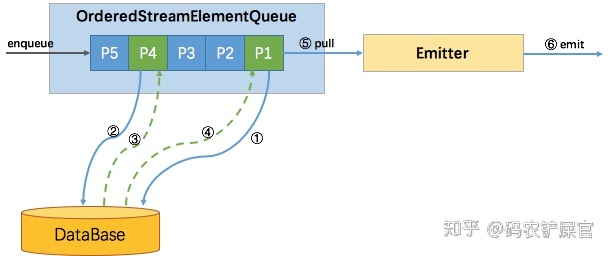
如上图,尽管 P4 的结果先返回,但并不会发送,只有 P1 (队首)的结果返回了,才会将P1(队首)的结果发送
实现原理:将 P4 结果缓存在队列中,在此之前的数据 P1、P2、P3全部完成并输出后,才输出 P4 的结果
缺点:
- 带来了一些额外的延迟
- 由于数据保存在
checkpoint内的时间会更长, 故checkpoint负载会增加
形参:传入参数与 unorderedWait() 相同
例子
package hbase;

import org.apache.flink.api.common.functions.FlatMapFunction;
import org.apache.flink.api.java.tuple.Tuple2;
import org.apache.flink.configuration.Configuration;
import org.apache.flink.streaming.api.datastream.AsyncDataStream;
import org.apache.flink.streaming.api.datastream.DataStreamSource;
import org.apache.flink.streaming.api.datastream.SingleOutputStreamOperator;
import org.apache.flink.streaming.api.environment.StreamExecutionEnvironment;
import org.apache.flink.streaming.api.functions.async.ResultFuture;
import org.apache.flink.streaming.api.functions.async.RichAsyncFunction;
import org.apache.flink.util.Collector;

import java.util.Collections;
import java.util.Random;
import java.util.concurrent.ArrayBlockingQueue;
import java.util.concurrent.ThreadPoolExecutor;
import java.util.concurrent.TimeUnit;

public class Std5AsyncDataStream_order {
    public static void main(String[] args) throws Exception {
        StreamExecutionEnvironment env = StreamExecutionEnvironment.getExecutionEnvironment();
        env.setParallelism(1);
        // 模拟数据
        DataStreamSource<String> dss = env.fromElements(
                "1李雷 2lucy",
                "3韩梅梅 4lili",
                "5李雷 6韩梅梅");
        // map解析json数据
        SingleOutputStreamOperator<Tuple2<String,Integer>> mapSOSO = dss.flatMap(new FlatMapFunImpl());

        SingleOutputStreamOperator<Object> soso = AsyncDataStream.orderedWait(mapSOSO, new RichAsyncFunction<Tuple2<String, Integer>, Object>() {
            // 创建线程池
            private ThreadPoolExecutor threadPoolExecutor;
            @Override
            public void open(Configuration parameters) throws Exception {
                //初始化线程池
                threadPoolExecutor =  new ThreadPoolExecutor(
                        10,
                        10,
                        0,
                        TimeUnit.SECONDS,
                        new ArrayBlockingQueue(1000));
            }

            /**
             * 每来一条数据,就执行一次该方法
             * @param input 输入数据
             * @param resultFuture 通过该对象收集数据
             * @throws Exception
             */
            @Override
            public void asyncInvoke(Tuple2<String, Integer> input, ResultFuture<Object> resultFuture) throws Exception {
                int delay = new Random().nextInt(10) * 100;
                threadPoolExecutor.submit(new Runnable() {
                    @Override
                    public void run() {

                        try {
                            System.out.println(String.format("模拟从数据库查询数据消耗的时间::%s ms,数据:%s",delay,input ));
                            Thread.sleep(delay);
                        } catch (InterruptedException e) {
                            throw new RuntimeException(e);
                        }
                        // 通过下面方法收集数据
                        resultFuture.complete(Collections.singleton(input));
                    }
                });
            }
        }, 30, TimeUnit.SECONDS);
        soso.print();
        env.execute();
    }
    public static class FlatMapFunImpl implements FlatMapFunction<String, Tuple2<String,Integer>> {
        @Override
        public void flatMap(String value, Collector<Tuple2<String, Integer>> out) throws Exception {
            String[] arr = value.split(" ");
            for(String item : arr){
                out.collect(Tuple2.of(item,1));
            }
        }
    }
}
执行结果:
方法选择
使用 unorderedWait 还是 orderedWait,主要看当前业务是否要保证顺序一致,如果不关注顺序,就选择 unorderedWait,如果要求顺序不能乱,就选择 orderedWait
真实案例
查询外部存储系统(MySQL、redis、Hbase)的案例:
flink 维表关联、翻译字典-热存储维表-使用AsyncDataStream、RichAsyncFunction 进行异步处理(查询MySQL)
flink 维表关联、翻译字典-热存储维表-使用AsyncDataStream、RichAsyncFunction 查询Hbase
参考:
https://blog.csdn.net/a724952091/article/details/108580882
https://zhuanlan.zhihu.com/p/364868336
https://zhuanlan.zhihu.com/p/268898593